What Are the Florida Building Code Hurricane Requirements
The Florida Building Code hurricane requirements set statewide wind loads, impact protection for openings, wind-resistant roofs, and a continuous load path. The 8th Edition (2023) governs permits today, and the 9th Edition takes effect on December 31, 2026. Miami-Dade County designs standard buildings for 175 mph gusts. Local code may be stricter, so confirm details with your permit office.
Key Takeaways
- The 8th Edition (2023) Florida Building Code took effect on December 31, 2023.
- The 9th Edition (2026) takes effect on December 31, 2026 for new permit applications.
- Wind-borne debris regions start at 130 mph near the coast and 140 mph elsewhere.
- Impact-rated glass or approved shutters protect openings, and the code accepts either.
- The roof 25 percent rule limits what a repair must bring up to current code.
What Are the Florida Building Code Hurricane Requirements?
The Florida Building Code hurricane requirements are statewide construction rules for wind speed, flying debris, and structural connections. The code covers design wind loads, protected openings, wind-resistant roofs, and a continuous load path from the roof to the foundation. Each area has its own tests and design limits.
Every permitted project follows these rules, from a custom home to a condo renovation. A wind-resistant home builder pulls the permit under the code edition in force on the application date. Plans examiners then review the drawings before work starts.
Florida Statutes section 553.73 deems the code adopted for use statewide without local adoption. Local governments can add technical amendments, so local code may be stricter. Confirm the details with your permit office or a licensed design professional. The edition date shapes every one of those details.
Which Edition of the Florida Building Code Applies Right Now?
The 8th Edition (2023) Florida Building Code applies right now. The 8th Edition took effect on December 31, 2023. Section 553.73 has the Florida Building Commission adopt a new edition every 3 years. The 9th Edition (2026) takes effect on December 31, 2026.
Miami-Dade County requires permit applications and plans submitted on or after that date to meet the new edition. Online portal applications filed after 4 PM on December 30, 2026 also fall under the 2026 edition. Confirm the transition date with the building department in other counties. Owners can read about permit thresholds before they submit plans.
Four steps confirm which edition governs a project.
- Find the date the permit application was or will be submitted.
- Match that date to the edition in effect on that day.
- Ask the plans examiner about local amendments in the jurisdiction.
- Keep the approved plans and product approvals in the project file.
The edition history explains why older homes follow older rules, so the timeline comes next.
When Did Florida Change Building Codes for Hurricanes?
Florida changed building codes for hurricanes in stages between 1974 and 2002, and the code has updated every 3 years since. The first statewide Florida Building Code took effect on March 1, 2002. That edition superseded all local building codes.
Hurricane Andrew struck South Florida on August 24, 1992 as a Category 5 storm. NOAA reports that Andrew damaged or destroyed 125,000 homes in Dade County. At least 160,000 people were left homeless.
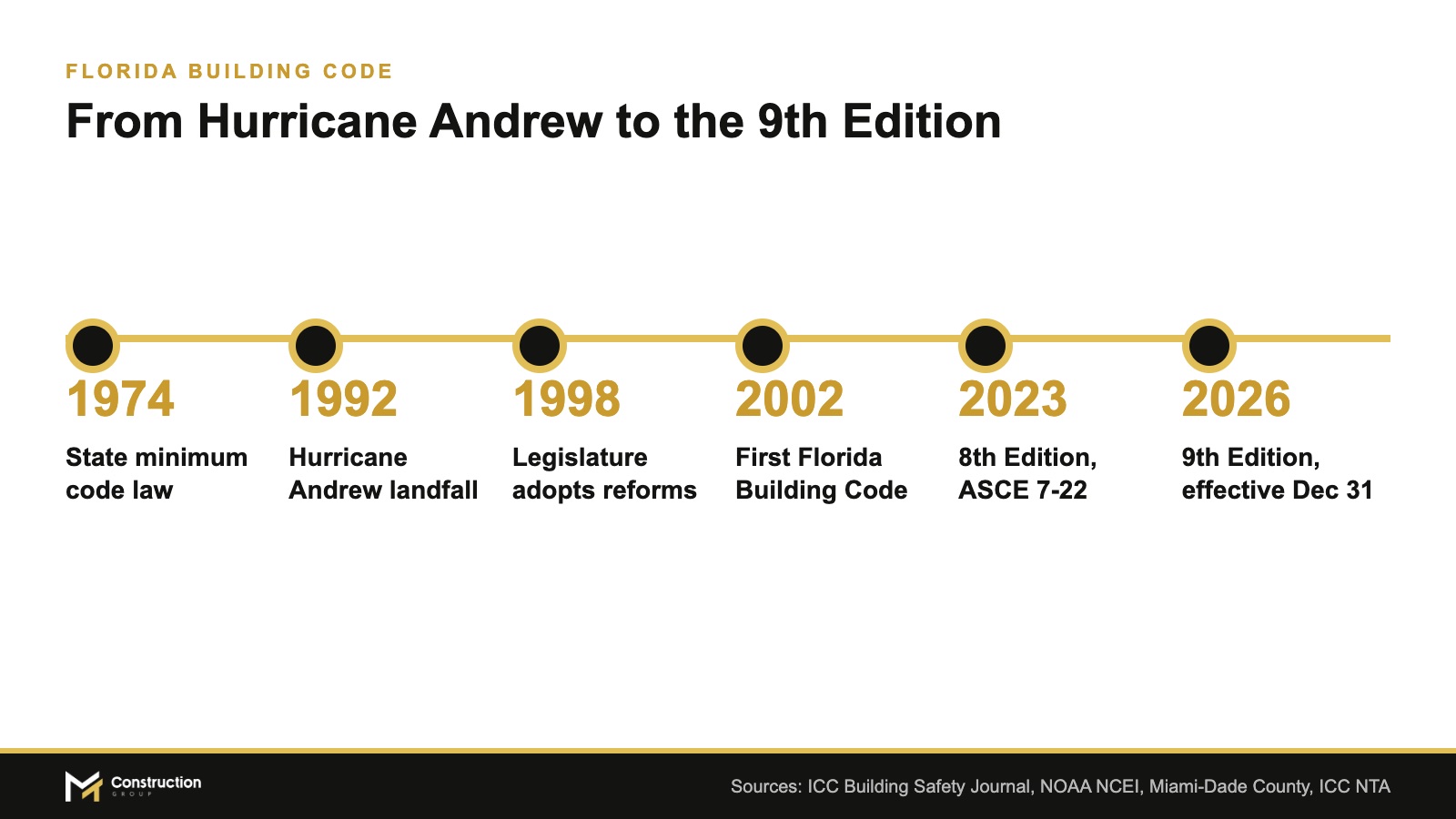
Governor Lawton Chiles then appointed the Florida Building Code Study Commission. The Legislature adopted the commission reforms in 1998. The table below lists the milestones.
| Date | Milestone | Effect |
|---|---|---|
| 1974 | State minimum building code law | Local codes written under state law |
| August 24, 1992 | Hurricane Andrew landfall | Exposed gaps in code adoption and enforcement |
| 1998 | Legislature adopts commission reforms | One uniform family of codes |
| March 1, 2002 | First Florida Building Code | Replaced all local building codes |
| December 31, 2023 | 8th Edition (2023) | ASCE 7-22 wind loads |
| December 31, 2026 | 9th Edition (2026) | Applies to new permit applications |
Each row on that list changed who builds to which wind standard. The graphic below shows the same sequence from Andrew to the 9th Edition.
What Are the Key Changes to the Florida Building Code in 2026?
The key change to the Florida Building Code in 2026 is the 9th Edition, effective December 31, 2026. ICC NTA lists the new edition across the Building, Residential, Accessibility, Energy Conservation, Fire Prevention, Fuel Gas, Plumbing, and Mechanical codes. The 2023 National Electrical Code sits beside them.
The 8th Edition already moved wind loads to ASCE 7-22. Designers should read the published 9th Edition structural chapters before finalizing drawings. Permit timing then decides which text applies.
The wind provisions inside those chapters start with design speeds.
What Are the Wind Requirements for Building Code in Florida?
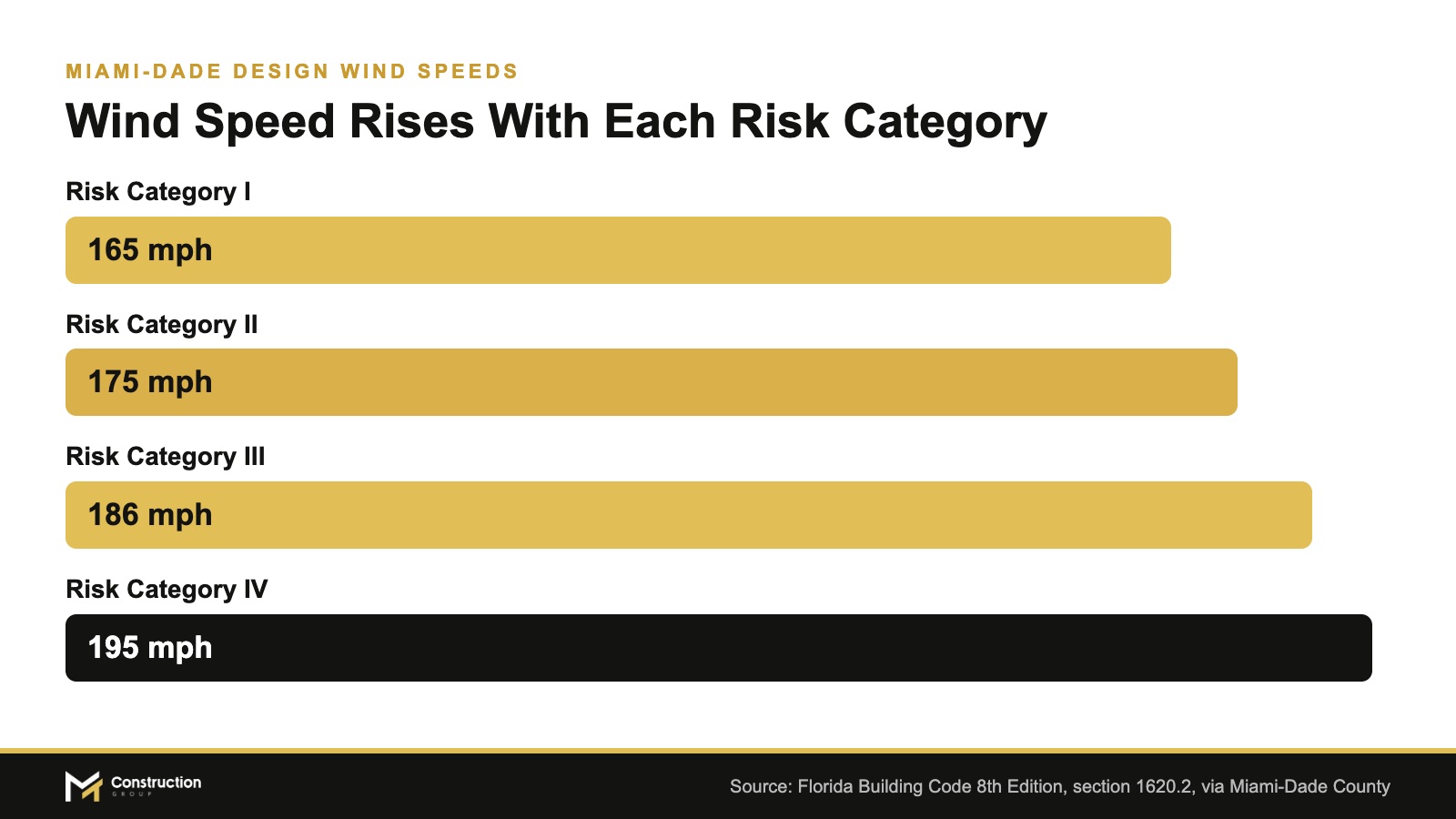
The wind requirements for building code in Florida start with the ultimate design wind speed. Engineers use this 3-second gust to size the structure. In Miami-Dade County, section 1620.2 sets 165 mph to 195 mph by risk category. Single-family homes are Risk Category II buildings under ASCE 7.
Risk Category II buildings in Miami-Dade use 175 mph. Higher categories cover buildings whose failure carries more risk to life. The table lists all four values.
| Risk Category | Design wind speed (3-second gust) | Code reference |
|---|---|---|
| I | 165 mph | FBC 1620.2 |
| II | 175 mph | FBC 1620.2 |
| III | 186 mph | FBC 1620.2 |
| IV | 195 mph | FBC 1620.2 |
Category IV covers essential facilities, and the speeds rise with each step. The graphic below turns those four speeds into a quick comparison.
Those design speeds drive structural connections. They also set where debris protection starts.
What Is a Wind-Borne Debris Region?
A wind-borne debris region is an area where the code requires protection for glazed openings. The definition has two triggers. The first covers land within 1 mile of the mean high-water line. An Exposure D condition must exist upwind, and the ultimate design wind speed must be 130 mph or greater.
The second trigger covers any area where the ultimate design wind speed is 140 mph or greater. Miami-Dade County publishes this definition in its summary of the 8th Edition changes. Check the site address with the building department.
Protection inside those regions follows product testing, and the window rules come next.
What Is the Code for Hurricane Windows in Florida?
The code for hurricane windows in Florida requires impact-resistant glazing or an approved covering on glazed openings in a wind-borne debris region. Products must pass missile impact and pressure tests before approval.
Miami-Dade Product Control uses three protocols. TAS 201 covers large and small missile impact. TAS 202 covers static pressure, and TAS 203 covers cyclic pressure.
Impact-rated and non-impact glazing need separate Notices of Acceptance. A Notice of Acceptance is the county approval document for a tested product. Statewide, Florida Product Approval plays the same role.
The same approval question applies to shutters, which raises the next requirement.
Are Hurricane Shutters Required by the Florida Building Code?
Hurricane shutters are not required by the Florida Building Code when the openings carry approved impact-resistant glazing. The code requires opening protection, not shutters by name. A tested shutter system satisfies the same rule.
Miami-Dade Product Control tests shutter types by dimension. Roll-up shutters are tested at a 7 foot height, and accordion shutters at a minimum 3 foot width. Storm panels follow their own deflection limits.
Fasteners matter near salt water. Miami-Dade testing guidance sets coastal fastener requirements within 3,000 feet of the saltwater coastline. Verify the product approval before installation.
Shutters protect openings, but they raise a related question about every window.
Do All Windows in Florida Have to Be Hurricane Proof?
No, not all windows in Florida have to be hurricane proof, because the rules depend on location and project type. Opening protection applies in wind-borne debris regions and in the High-Velocity Hurricane Zone. No product is rated hurricane proof, only tested to a protocol.
Renovations can trigger protection as well. Section 553.844 requires opening protection on permitted work applied for on or after July 1, 2008 that costs $50,000 or more. The building must sit in a wind-borne debris region with an insured value of $750,000 or more.
Roof covering repair or replacement is excluded from that trigger. A high-end remodeling scope can cross the $50,000 line quickly, so budget windows into the plan early. Ask the plans examiner how the building department counts cost.
Roofs carry their own repair trigger, and it uses a percentage.
What Is the 25 Rule in Florida Building Code?
The 25 rule in Florida Building Code is the roof rule. It decides how much of a roof must meet current code after a repair. Repairing 25 percent or more of a roof section triggers the rule. The roof's age and build year decide the outcome.
Section 553.844(5) sets an exception for newer roofs. A roof built or replaced under the 2007 Florida Building Code or later needs only the repaired portion to meet current code. Local governments may not amend that exception.
Older roofs do not get that exception. Their repairs can pull the whole roof section up to current code. Confirm your roof's build year with the permit record.
What Is the 25% Roof Rule in Florida?
The 25% roof rule in Florida measures the share of a roof section that a repair, replacement, or recovering touches. The rule counts 25 percent or more of the roofing system or roof section. The graphic below shows how the decision works.

Owners who hire an addition builder should check this rule before tying a new roof into the old one. The tie-in touches the existing roof section. The permit set shows the roof area involved.
Wind loads, openings, and roofs make up the core rules, and a few side questions remain.
What Else Should You Know About Florida Building Code Hurricane Requirements?
Several side questions shape how the Florida Building Code hurricane requirements affect owners and buyers. Each answer below uses the same sources.
Can You Sell a House in Florida Without Hurricane Shutters?
Yes, you can sell a house in Florida without hurricane shutters, because the building code governs design and construction rather than sales. The code regulates construction work, and section 553.73 defines it that way. Lenders and insurers can set their own conditions.
Wind inspection reports document existing opening protection for a buyer. Review the contract terms with a Florida real estate attorney. A builder search before listing can price retrofit work.
What Structures Are Exempt From Florida Building Code?
Section 553.73(10) exempts specific structures from the Florida Building Code. Storage sheds of 720 square feet or less are exempt when they are not designed for human habitation. Other exemptions include nonresidential farm buildings and temporary construction sheds.
The statute also exempts family mausoleums up to 250 square feet. Hunting structures under 1,000 square feet owned by a natural person qualify under conditions. Federally regulated buildings are exempt as well.
The shed exemption carries wind-borne debris and door conditions in the statute. Check section 553.73(10) before building without a permit.
Why Doesn't Florida Build Hurricane Proof Homes?
Florida does not build hurricane proof homes because the code designs for a defined wind speed, not for every possible storm. Design speeds range from 165 mph to 195 mph in Miami-Dade, and risk category sets the value. A storm can exceed a design load.
Hurricane Ian made landfall on September 28, 2022 with 150 mph winds near Fort Myers. The FEMA assessment team found no wind-related structural damage to any home built under the Florida Building Code. A 2022 home designed for 161 mph showed no visible damage at an estimated 113 mph.
What Are Florida Building Code Hurricane Zones?
Florida building code hurricane zones are the High-Velocity Hurricane Zone and the wind-borne debris region. The High-Velocity Hurricane Zone covers Miami-Dade and Broward counties. It adds product approvals and Chapter 16 wind provisions such as the section 1620.2 speeds.
The wind-borne debris region reaches beyond those two counties. Areas at 140 mph or greater qualify, and so does land within 1 mile of the coast at 130 mph or greater. Ask the building department which zone covers the parcel.
How Did Newer Homes Perform in Hurricane Ian?
Newer homes performed better in Hurricane Ian, according to the FEMA assessment team. Newer roof coverings generally performed better than older coverings. Hips and ridges were still the most prevalent roof damage on newer and older roofs.
The ICC Building Safety Journal summarizes the findings. Repair work after a storm still needs a permit, and permit lifespan sets how long that permit stays open. Plan the timeline with the building department.
Does the Same Code Apply to Condos and Commercial Buildings?
The Florida Building Code applies to condos and commercial buildings through its Building volume. The Residential volume covers one- and two-family homes. Risk category changes the wind speed. Category III and IV buildings face higher speeds and tornado provisions in Miami-Dade.
Permits for condo renovation projects follow the same edition rules. Association rules can add window and shutter standards on top. Review them before ordering products.
Frequently Asked Questions About Florida Building Code Hurricane Requirements
Can I Install My Own Hurricane Shutters?
Installation rules depend on the product approval and the local building department. Florida Product Approval and Miami-Dade Notice of Acceptance documents list installation conditions. Confirm permit and licensing needs with the permit office before buying.
What Is Better, Hurricane Windows or Shutters?
Both meet the code when the product carries approval for the location. Impact windows stay in place all year. Shutters must be installed or closed before a storm. Compare product approvals, design pressures, and installation conditions.
Do I Need a Permit to Install Hurricane Shutters?
Permit rules vary by jurisdiction and by shutter type. The building department decides whether a permit applies to the product and the anchors. Call the permit office with the product approval number.
How Does MT Construction Group Help With Hurricane-Ready Building?
We build to the code edition in force at permit submission. We manage ground-up residential builds from permit acquisition through final inspection. Our drawings for luxury residential projects reflect wind loads and opening protection. Plans examiners review those drawings against the edition in force. Inspectors then check the finished work against the approved permit set.
Product approvals, plans, and inspections need one coordinator who tracks every document from submittal to closeout. A custom home contractor keeps each approval attached to the permit set and the field inspections. Review any project with your permit office and a licensed professional. Permit fees and schedules vary by jurisdiction.
Questions about a hurricane-ready build are welcome, and a quote request starts the conversation with MT Construction Group and the project team.