What Renovations Can You Do in a Condo

Condo renovation rules let owners remodel everything inside the unit once the association and the city approve the plans. Florida Statutes 718.113 reserves common elements to the board, and a 75 percent owner vote applies when the declaration is silent. Walls, plumbing and electrical work also need a city permit, and hard flooring needs an impact rating of IIC 50.
Key Takeaways
- Owners can renovate finishes, fixtures, cabinets and layouts inside the unit, with written association approval.
- Wall removal, plumbing and electrical changes need a city permit, and painting does not.
- Florida Building Code section 1207.3 sets a floor impact rating of IIC 50 between dwelling units.
- Association fines for rule violations are capped at $100 per violation or $1,000 in the aggregate.
- Midrange bathroom remodels recouped 80 percent of cost in the 2025 Cost vs Value report.
What Are the Condo Renovation Rules Florida Owners Must Follow?
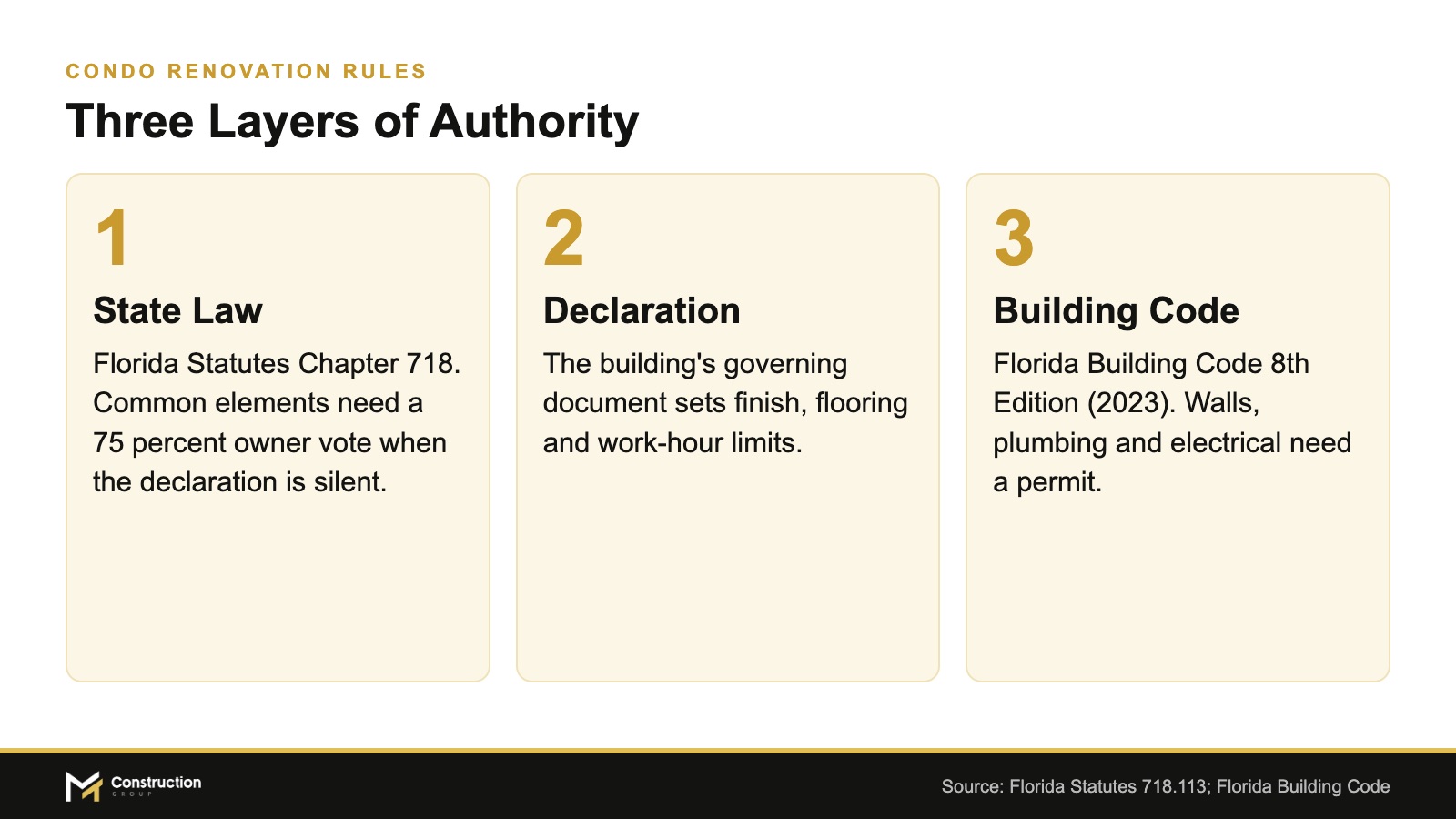
The condo renovation rules Florida owners must follow come from three layers of authority. Those layers are state law, the declaration and the building code. Each layer controls a different part of the project.
State law is Florida Statutes Chapter 718, known as the Condominium Act. Section 718.113(3) bars an owner from any act that adversely affects the safety or soundness of common elements. The declaration is the building's governing document, and it adds finish, flooring and work-hour limits.
The building code is the Florida Building Code, Building, 8th Edition (2023), and the local building department enforces it. We plan every luxury condo renovation around these three layers, starting with the declaration.
The figure below summarizes what each layer controls. Chapter 718 covers common elements, the declaration covers unit rules, and the code covers permits.
These layers set the boundaries, so the next step is to see which renovations each layer allows.
What Kind of Renovations Can You Do in a Condo?
The renovations you can do in a condo cover finishes, fixtures, cabinets and interior layouts inside the unit boundary. Each project still needs the association's written approval where the declaration requires it.
The table below sorts common projects by city permit need, using the permit guidance Miami-Dade County publishes. The association column shows the step to confirm in your own declaration.
| Project | County permit | Association step to confirm |
|---|---|---|
| Interior painting or wallpaper | Not required | Finish and color rules in the declaration |
| Ceiling fan in an existing outlet | Not required | Work-hour and contractor rules |
| Floor resurfacing | Not required | Flooring and sound rules |
| New hard flooring over carpet | Separate flooring permit in some cities | Written approval with an IIC 50 rating |
| Wall removal | Required | Written approval and plans |
| Plumbing or electrical changes | Required | Written approval and licensed trades |
| Water heater replacement | Required | Written approval and shutoff schedule |
Declarations differ by building, so the association's renovation packet decides the final list for your unit. The packet also marks where the unit ends and the common elements begin.
Can You Renovate the Interior of a Condo?
Yes, you can renovate the interior of a condo, because the unit itself is exclusively owned. Florida Statutes 718.103 defines a unit as the part of the condominium property subject to exclusive ownership.
The same statute defines common elements as the portions of the condominium property not included in the units. Structure, shared pipes and exterior walls fall on the common side. The declaration sets the exact boundary line.
The boundary matters because interior walls, pipes and wiring can belong to either side. Read the declaration before you design a layout, and ask the board to confirm any wall you plan to move.
The boundary also decides who must approve each change, so association approval is the next question.
Do You Need Association Approval to Renovate a Condo?
Yes, you need association approval to renovate a condo when the work touches common elements or a category the declaration restricts. Written approval is the document the city and the contractor will ask for.
Common elements follow a stricter rule. Section 718.113(2)(a) bars material alteration of common elements except as the declaration provides. Without a stated procedure, 75 percent of the total voting interests must approve the change.
Windows and shutters have their own rule. Section 718.113(5) requires each board to adopt hurricane protection specifications for every building. Owners who replace windows or shutters follow those specifications, including color and style.
Written approval protects the owner during the permit and closing stages. Bathrooms combine pipes, waterproofing and floors, so approval needs extra care in that room.
Can You Renovate a Bathroom in a Condo?
Yes, you can renovate a bathroom in a condo, with board approval and a permit for any plumbing or electrical change. Painting the room needs no permit, and moving a drain does.
Miami-Dade County requires a permit for altering or repairing plumbing or electrical systems. The City of Miami Beach condo checklist also lists a waterproofing specification sheet among the supporting documents.
Cost planning starts with a national figure. The 2025 Cost vs Value report lists a midrange bath remodel at a $26,138 job cost and 80 percent recouped.
Plumbing is where bathroom plans meet the building's shared pipes, so plumbing rules come next.
Can You Change the Plumbing in a Condo?
Yes, you can change the plumbing in a condo, but only the lines the declaration places inside your unit. Shared stacks and risers serve several units, and the association's rules govern any work on them.
A permit applies to every plumbing change under county guidance, including a hot water heater replacement. Florida Statutes 553.79 makes altering a building without a permit unlawful.
A licensed contractor pulls the permit and handles the work. Florida Statutes 489.103(7) limits owners who act as their own contractor and bars them from delegating supervision to anyone unlicensed.
Plumbing approval is one step in a longer sequence, so the approval process is the next topic.
How Do You Get Condo Renovation Approval and Permits?
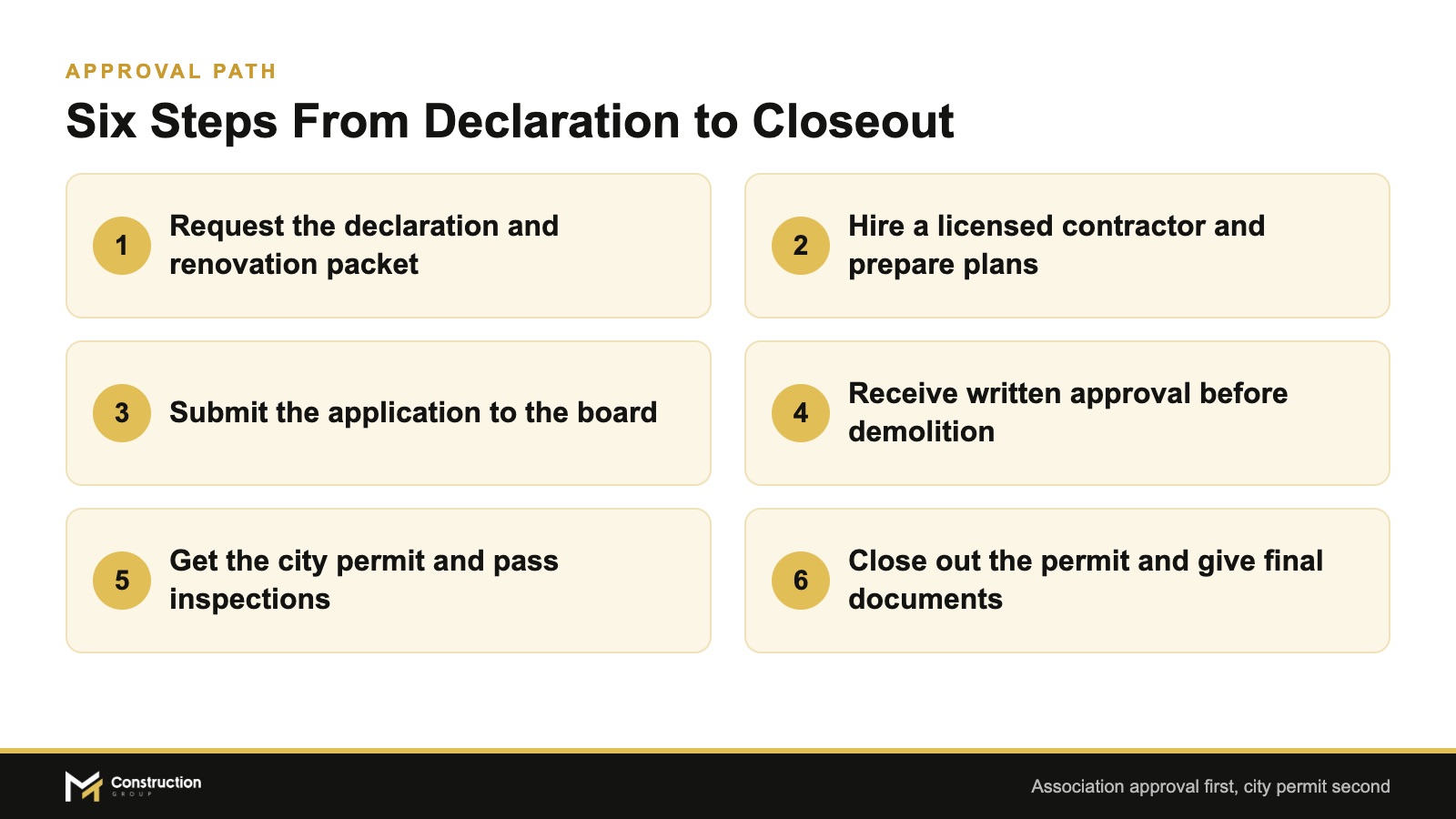
Get condo renovation approval and permits by following association approval first and the city permit second. The condo renovation guidelines below follow that order.
- Request the declaration, rules and renovation packet from the association office.
- Hire a licensed contractor and prepare plans, material lists and a work schedule.
- Submit the application, plans and contractor details to the board.
- Receive the board's written approval before any demolition starts.
- Apply for the city permit and pass each inspection within the permit window.
- Close out the permit and give the association the final documents.
The City of Miami Beach checklist for a condo interior alteration without structural work shows how deep the review runs. Building, fire, electrical, mechanical and plumbing reviewers can all examine the plans, and the drawings must be signed and sealed.
Fees are a separate cost. Our guide to permit budgeting explains how owners plan for them.
The graphic below shows the same six steps in order, from the declaration to closeout.
Every step adds time, so the schedule is the next question.
What Is the Typical Timeline for Renovating a Condo?
The typical timeline for renovating a condo runs through four phases, which are association review, permitting, construction and inspections. Each phase has its own clock.
Published duration figures vary because scope, board meeting schedules and delivery windows differ. Ask each bidder to list review, permit and build weeks separately.
Two clocks have fixed numbers. A Miami-Dade permit gives 180 days to finish work and call inspections. An approved inspection extends the permit another 180 days. Our note on permit validity covers the rule in more detail.
Work hours also shape the schedule. The City of Miami allows construction Monday to Saturday from 8 AM to 6 PM. After-hours work needs a noise waiver filed 15 business days ahead, and buildings can set tighter hours.

The graphic above lists these four numbers. A phased plan, like the design-build steps we use, keeps each clock visible from the start.
Time and money move together, so the budget is the next question.
How Much Does It Cost to Renovate a 1000 Sq Ft Condo?
The cost to renovate a 1000 sq ft condo starts with room-level figures, such as $26,138 for a midrange bathroom. A major kitchen remodel reaches $82,793 at the same national averages. No government agency publishes a single price per condo.
The table below uses national averages from the 2025 Cost vs Value report by Remodeling magazine. The averages are not specific to condos or to South Florida.
| Project | Job cost | Resale value | Cost recouped |
|---|---|---|---|
| Midrange bath remodel | $26,138 | $20,915 | 80% |
| Minor kitchen remodel | $28,458 | $32,141 | 112.9% |
| Major kitchen remodel | $82,793 | $42,130 | 50.9% |
Condo projects add building costs on top of these averages. Elevator reservations, shared-area protection, debris removal and association fees change a bid. Any condo renovation contractor should list them as separate lines.
Resale value is the other half of the budget, so value is the next question.
What Adds the Most Value to a Condo?
A minor kitchen remodel adds the most value to a condo among the table projects, recouping 112.9 percent of cost. The Cost vs Value report measured that figure against resale value.
The midrange bath remodel recouped 80 percent, and the major kitchen remodel recouped 50.9 percent. Larger scopes cost more than they return at resale.
Value also depends on the building. A remodel that breaks flooring or sound rules can create disputes with neighbors. Our renovation ideas article covers finish choices that suit a high-end unit.
Value is one of several topics owners ask about, so the next section covers the rest.
What Else Should You Know About Condo Renovations?
Can You Renovate an Apartment That You Own?
Yes, you can renovate an apartment that you own, and the rules depend on the building type. Condo owners follow Chapter 718. Florida Statutes Chapter 719 governs residential cooperatives, so cooperative owners check that chapter and their own bylaws.
What Are Small Condo Renovation Rules?
Small condo renovation rules match the rules for larger units, because the statutes and county guidance cited here set no size threshold. A wall removal in a studio needs the same permit as one in a penthouse. Association packets set the final limits.
What Are New Condo Renovation Rules?
New condo renovation rules start with the developer's declaration and the 8th Edition code. Building age adds inspections later. Florida Statutes 553.899 requires a milestone inspection in the year a building of three or more habitable stories reaches 30 years.
What Are the Flooring and Soundproofing Rules for a Condo?
The flooring and soundproofing rule for a condo is an impact insulation class (IIC) rating of at least 50. Florida Building Code section 1207.3 sets that rating for floors between dwelling units. A field test needs an apparent rating of 45.
The City of Miami Beach checklist adds a soundproofing specification sheet and a separate flooring permit. Association packets can also require proof of the rating before approving hard flooring.
What Are the Rules for Contractors in a Condo?
Rules for contractors in a condo cover licensing, work hours, delivery routes and shared-area protection. A licensed Brickell condo renovation team follows the same layers of authority as any other building. The association packet lists insurance and elevator requirements. Ask the office for the current certificate-of-insurance wording before a contractor submits the application.
What Happens If You Renovate Without Approval?
Renovating without approval exposes the owner to fines and permit violations. Florida Statutes 718.303 caps association fines at $100 per violation or $1,000 in the aggregate. The board must give 14 days written notice and a hearing before a committee.
A missing permit is a separate problem. Our guide to permit triggers lists the projects that need one.
Do Lead and Asbestos Rules Apply to Condo Renovations?
Yes, lead and asbestos rules apply to older condo buildings. The EPA Renovation, Repair and Painting Rule covers paid work that disturbs paint in homes built before 1978. The City of Miami Beach checklist requires an asbestos survey when more than 160 square feet of suspect material is disturbed.
Frequently Asked Questions About Condo Renovations
What Are the Biggest Renovation Mistakes?
Starting work before written approval and skipping a required permit are the mistakes with legal exposure. Florida Statutes 553.79 makes unpermitted alteration unlawful, and section 718.303 allows association fines. Choosing flooring below the IIC 50 rating adds a third risk.
What Counts as a Major Renovation?
A major renovation changes structure or building systems and requires a permit. Miami-Dade County lists wall removal and changes to plumbing, electrical or gas systems as permit work. Painting and floor resurfacing do not count.
What Is the Most Expensive Part of a Renovation?
Among the projects in the 2025 Cost vs Value table, the major kitchen remodel is the most expensive at $82,793. The midrange bath remodel costs $26,138, and the minor kitchen remodel costs $28,458.
What Is the Correct Order of a Condo Renovation?
The correct order of a condo renovation is approval, permit, demolition, rough-in work, inspection, finishes and closeout. Plumbing and electrical rough-in come before walls close. Flooring and cabinets follow, and the permit closes last.
How Does MT Construction Group Help With a Condo Renovation?
We manage every condo project from the first building assessment to handover. One named person oversees the work, and you approve every finish before procurement begins. Our team delivers condo remodeling within the building's rules.
Each project follows association rules, approved working hours and the Florida Building Code. Permits and inspections follow county requirements from the first drawing to the final sign-off. Completed work appears in our construction portfolio for owners to review.
Owners planning a larger remodel or addition can compare scope options before they apply. Every option starts with the same approval sequence, so the schedule stays realistic. Our luxury residential services cover those larger projects, from the first plan to the final inspection and handover.
To start a condo project, send the declaration and a short scope through the estimate form. We reply with the approval and permit steps for your building, so the board application is complete on the first submission.
Questions about the sequence are welcome at any stage. Contact MT Construction Group to plan the approval path before the first drawing is finished and before the board meets.